.jpg)
Micro-organises in Virtual reality
Honours Project
Background
Not everything in school or life can be taught through books, many things have to be experienced.
Plants and micro-organise have one thing in common, the average person will never see them close up. So why not use the power of virtual reality, planning, design, scientific discovery and creativity to make a fun and informative experience that lets kids to grandparents see these in a scale size thousands of times large then possible in reality so you can see and therefore understand and appreciate how they operate.

Planning and Design
Design
During research for this project I identified ShareCare VR 2017, as excellent example of taking what we can't see and making it visible to all in a health environment.
After experiencing this VR environment I identified there were many positives features but there were also opportunities where it could be improved.
One of the major opportunities that I planned to improve was how you can lose your orientation within this "Void" world through their teleportation interface. Whilst, if correctly used, it works well with inexperienced users of VR, however it was difficult to regain orientation leading to frustration and focusing on the game interface and not content.
The development process
Designing and modelling
My research indicated that having a familiar environment would shorten the time for less experienced / new to VR users to navigate the environment. So I chose a traditional Class Room Lab.
I collaborated with a 3D modeler from another country taking my concept drawings and developing a base model. Using tools like VRChat to test and develop the models in real time.

Lighting and texturing
My research had determined that the lighting had to be realistic and calming to limit disorientation. So using baked lights in the celling and a directional sun that streams in from the windows I was able to achieve a level of realism that limited any users feeling nauseous.

The project required factually accurate representations of micro-organisms due to the application being designed for educational purposes.
All models were acquired from sketchpad and edited/adjusted in blender.

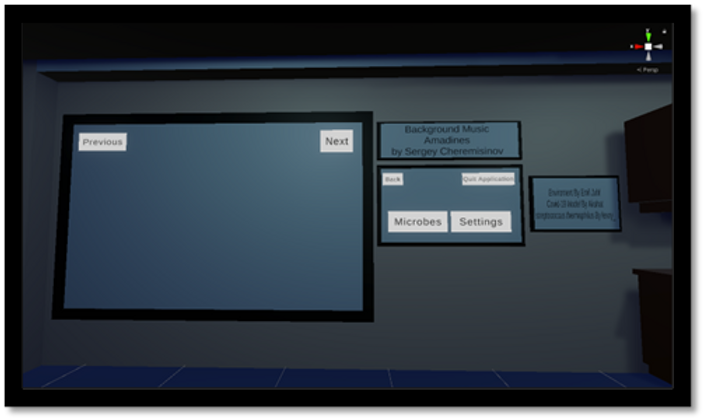
The Main Menu System
Class whiteboard
Whiteboard
Before creating the menu systems I took the time to experience other virtual reality games with their menu system to see how they handled the un-natural interactive screen.
VRChat
Pistol Whip
Beat Saber
After experiencing these games, a question that could be answered through this project was "Do users prefer a static menu system in world?". So instead of creating a futuristic laboratory with floating monitors everywhere I decide to retain a centralised area by using the whiteboard as the menu system. This also worked well with the concept of using a recognisable environment.
Conclusion/ Response
This study has concluded that the VR did as well as the traditional paper-based learning and they enjoyed being able to interact with the models, but it also exposed several insights that would indicate that further research and development of the VR experience could substantially enhance this learning experience. These insights include the users whilst being comfortable in a classroom environment quickly expressed the desire to be even more interactive. Their attention drops whilst reading text as they felt it was not easy, and whilst they were given the freedom to move around, they tended to take on a fixed position within the model.
Working with a friend
Knowing my own weaknesses I asked a good friend of mine who just left University for architecture and 3D modelling to work alongside me.
With his help we build an environment that will inspire people and get them excited to see these micros.